Hardware And Software Integration, Covering Multiple Application Scenarios
 2026-10-26
I. Case at a Glance
Project Dimension | Content |
Case Name | Mexico–US Livestock Border Crossing Pilot (MX-US Livestock Border Crossing Pilot) |
Implementer | Fort Supply Technologies (Oklahoma, USA; supplier of UHF livestock eartags and traceability systems) |
Time and Location | December 2021–January 2022; Jeronimo Crossing, Mexico ↔ Santa Teresa Crossing, New Mexico, USA |
Scale | 401 cattle tagged at the start; 393 arrived at the crossing; 390 of which wore UHF eartags |
Stakeholders | USDA (United States Department of Agriculture), SENASICA (Mexico's National Service for Agro-Alimentary Health, Safety and Quality), New Mexico Livestock Board, Five Rivers Cattle Feeding, JBS USA |
Core Pain Points | About 1.6 million Mexican cattle enter the US each year for feeding and slaughter; visual eartag transcription has a high error rate; low-frequency (LF) electronic eartag pilots could not achieve acceptable read rates without changing cattle handling practices |
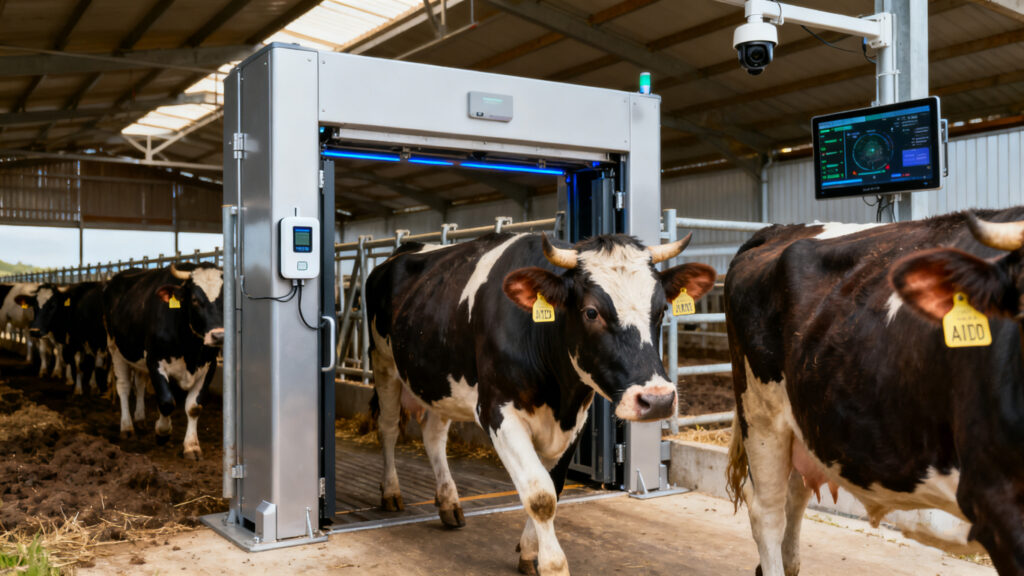
Technical Solution | Triple identification per head (Mexican official SAGARPA nested LF + visual tag / USDA tuberculosis blue metal clip tag / Fort Supply UHF strip eartag) + fixed autonomous UHF reader + semi-autonomous handheld + Fast HERD cloud platform |
Key Results | At both checkpoints—the weighbridge and the USDA entry inspection—390/390 = 100% automatic reads were achieved; cattle passed at normal commercial speed with no slowdown, no facility modification, and no manual involvement |
Comparison Baseline | 2017 pilot at the same crossing: manual visual transcription of 151 cattle produced 10 misreads (6.7% error rate), while the UHF electronic system produced zero misreads |
Sources | Fort Supply Technologies official use-case document (published June 2022); USDA APHIS Ultra-High Frequency Demonstration Project state reports; Progressive Cattle industry media |
One-sentence summary: The value of this project is not "swapping eartags for electronic ones," but proving that only UHF can automatically and completely capture individual identities at the speed of normal cattle movement, without modifying any facilities. This is exactly what LF cannot do and what border crossings need most.
II. First, Make One Premise Clear: UHF in Livestock Is a "Supplementary Layer," Not a "Replacement Layer"
Before pitching UHF solutions to overseas livestock customers, one thing must be made clear first, or you will step into a trap—the global legal standard for livestock electronic identification has long been low frequency (LF, 134.2 kHz, ISO 11784/11785), not UHF.
2.1 Timetable for Mandatory Electronic Identification by Country
Country / Region | Subject of Mandatory Electronic Identification | Effective Date |
Australia (NLIS) | Cattle | 2005 |
Canada | Cattle | July 2010 |
European Union | Sheep, goats | January 2010 |
United States (USDA ADT Final Rule) | Cattle/bison 18 months and older that are not castrated, all dairy cattle, cattle used in shows and competitions | November 5, 2024 |
Australia (NLIS expansion) | Sheep, goats | January 2025 |
Brazil | Cattle (individual EID) | 2027 (planned) |
Note: The timeline above is compiled from publicly available industry sources; specific scope of application and exemption clauses are subject to the latest official texts of each country.
2.2 Three Sales Judgments Derived from This
1. Positioning judgment: Do not package UHF as a "replacement for official eartags." In APHIS documents, USDA 840-series official eartags are described as "visual tags, or tags with variable frequency RFID technology," but what USDA actually issues and recognizes today is still predominantly 134.2 kHz. Any claim that "with our UHF eartags you don't need official tags" will get customers stopped at customs.
2. Scenario judgment: UHF's main battleground is "mobile links"—border clearance, weighbridge weighing, loading for transport, feedlot sorting, and pass-by data capture at pasture water points/feeding points. What these scenarios share is that cattle are moving normally, cannot stop, and cannot be scanned one by one at close range.
3. Form judgment: The most reliable deployment form is "dual-tag parallelism": official LF/visual eartags satisfy compliance, while UHF eartags carry automated data capture. This case is exactly this form—each head wore three sets of identification. This is not embarrassing; this is reality.
III. Project Background: The Traceability Gap of 1.6 Million Cattle Crossing the Border Each Year
3.1 Biosecurity Pressure
About 1.6 million Mexican cattle cross the border into the United States each year, complete feeding in US feedlots, and then are slaughtered. To prevent exotic diseases from entering the US cattle herd, USDA and Mexico's SENASICA, together with state government officials from both countries and livestock industry associations, established a set of biosecurity measures: pre-entry preparation and testing, individual on-site inspection at the border, and continuous tracking of cattle movement during feeding and slaughter.
3.2 Failure of Traditional Practices
Historically, animal identification relied on visual eartags, with status and movement records kept on paper documents or spreadsheets. This approach has two fatal flaws: first, transcription depends on human eyes, so dirt, wear, and illegible writing lead to misreads; second, records are separate from the animal, so data cannot be generated automatically at the moment the animal moves.
3.3 The Failure of the LF Solution—This Is the Most Important Background of This Case
Fort Supply's official document states it plainly: earlier border-crossing pilots using low-frequency EID could not achieve acceptable read rates without significantly changing cattle handling practices.
The weight of this sentence lies in the fact that it comes from a company that also makes UHF livestock eartags, yet it did not conceal the reason LF failed—LF's read distance dictates that cattle must be driven into extremely narrow chutes and brought close to the antenna one by one, which means the clearance process must be reshaped, labor increased, and cattle stress increased. For a border crossing handling large numbers of cattle every day, this is an unacceptable cost.
3.4 The 2017 Comparison Pilot: 6.7% Visual Misread Rate
In April 2017, commissioned by the New Mexico Livestock Board and working with USDA, Fort Supply demonstrated the value of UHF eartags in the same border area. This pilot left a highly persuasive set of comparison data:
Comparison Item | Manual Visual Reading | UHF Electronic Reading |
Number of cattle in pilot | 151 head | 151 head |
Number of misreads | 10 | 0 |
Error rate | 6.7% | 0% |
Cause of misreads | Eartags dirty and illegible; required cleaning before re-reading and checking against the electronic system | Not applicable |
First-time user performance | Requires training; subject to subjective judgment | Untrained personnel can achieve 100% read rate |
Even more noteworthy is the performance of first-time users: personnel new to the device achieved 100% read rates when scanning in a 12-foot (about 3.7-meter) wide alley, scanning while unloading cattle from trucks, or scanning while walking past pens. This shows that UHF's value does not depend on operator skill.
IV. Technical Solution: A Four-Layer Architecture Breakdown
4.1 Identification Layer—Triple Identification per Head
Three to four weeks before cattle arrived at the border crossing for inspection and clearance, tagging was completed at a staging facility in Mexico. Each head was assigned three unique IDs:
Identification | Type | Nature and Function |
SAGARPA ID | Nested low-frequency (LF) + visual dual tag | Mexican official cattle identification |
USDA Tuberculosis ID | Blue metal clip tag | Mandatory USDA requirement for cattle entering from the southern border |
Fort Supply UHF strip tag | UHF passive eartag | The automated data capture carrier for this pilot |
The three IDs were paired in Fort Supply's Value Tracker application (running on rugged tablets), and uploaded to the Fast HERD cloud platform together with animal sex, geolocation, date, and timestamp. This "triple-tag pairing" action is the key to the solution's compatibility with the existing regulatory system.
4.2 Capture Layer—Fixed Primary, Handheld Auxiliary
Deployment Location | Equipment Form | Function |
Border crossing weighbridge | Fixed autonomous UHF reader + antenna | Automatic individual identification as cattle pass over the scale in lanes |
USDA entry inspection point | Semi-autonomous handheld UHF device | Runs in parallel with USDA manual inspection process, capturing IDs simultaneously |
Staging facility tagging station | Rugged tablet + Value Tracker application | Triple-tag pairing, attribute entry, cloud upload |
Subsequent feedlot and slaughter stages | Continuous tracking (project states monitoring will continue) | Extending to the full feeding and slaughter chain |
4.3 Transport Layer and Platform Layer
• Cloud synchronization: Data generated by tagging and reading is automatically synchronized to the Fast HERD cloud platform, updating each animal's geolocation, date, and timestamp in real time.
• Offline tolerance: Readers cache data locally in rural areas without network coverage and upload once in coverage—a point also emphasized in the Zimbabwe case.
• Event model: The platform aggregates all events by individual (tagging, movement, inspection, vaccination), forming a traceable time series.
V. Actual Test Process and Data from Three Checkpoints
Time | Stage | Quantity | UHF Read Result |
2021-12-13/14 | Tagging at Mexican staging facility | 401 head tagged | Baseline data established |
2022-01-18/20 | Arrived at Jeronimo Crossing, weighed in lanes | 393 head arrived | 390 head automatically identified (99.2% of total arrivals) |
2022-01-18/20 | Same as above, counted by actual UHF tag wearing | 390 head tagged | 390/390 = 100% all read |
1–3 days after crossing | USDA entry inspection point | 390 head | 390/390 = 100% all identified |
Regarding the discrepancy among the numbers 401 / 393 / 390, the official document provides a clear explanation:
• 401 head were tagged at the start, but ultimately only 393 head arrived at Jeronimo Crossing—normal cattle movement differences occurred in between.
• Post-hoc verification found that 3 of the 393 head that arrived were not wearing UHF eartags.
• Therefore, the denominator should be calculated as "390 head actually wearing UHF tags," giving a read rate of 100%, not 99.2%.
This detail is worth noting: the project proactively disclosed the numerical basis, rather than using 390/390 to cover up the fact that 3 of 393 head lacked tags. When presenting solutions to customers, clarifying the basis actually builds more trust.
5.1 Three "Zero Costs"—The Hardest Conclusion of This Project
1. Zero slowdown: Cattle passed at unrestricted commercial speed, with no slowdown and no queuing for individual scanning.
2. Zero modification: No facility modification was needed at the border crossing or staging facility; no new narrow chutes or driving facilities were required.
3. Zero manual labor: When fixed readers were operating, Fort Supply personnel were only present to supervise; the identification and recording process involved no manual participation.
In addition, the official document also notes that the UHF solution simultaneously improved cattle and operator safety and reduced stress—a point that, in an era of increasing buyer and regulatory attention to animal welfare, is itself a value point worth communicating externally.
VI. Why LF Cannot Do This Here: UHF vs. LF Comparison
Comparison Dimension | Low Frequency LF (134.2 kHz) | Ultra-High Frequency UHF (860–960 MHz) |
Regulatory status | Mainstream/only recognized frequency band for mandatory electronic identification in various countries | Not yet an official ID in most countries; must run in parallel with official tags |
Typical read distance | Requires close proximity or entry into an extremely narrow chute | USDA official report: panel antenna reads cattle running past at 20 feet; handheld about 10 feet; PDA about 6 feet |
Passage method | Must significantly change cattle handling practices | Normal walking speed suffices; commercial speed unrestricted |
Batch reading | Essentially one-by-one reading | Batch capture when a group passes through together |
Facility modification | Requires new narrow chutes and restricted formation | No modification needed (verified in this case) |
Human/animal safety and stress | Requires driving animals close; higher stress | Long-distance capture; lower stress |
Known shortcomings | Short read distance, low efficiency | Requires line of sight: cannot penetrate a cow's head, nor read a tag obscured by another cow |
Cost (USDA demonstration project basis) | 840 LF official eartags about $2.25–7.00 each | UHF eartags about $3.25 each (Colorado report) |
Compress this table into one sentence: LF wins on compliance, UHF wins on automation in mobile links. The two are not substitutes but a division of labor—LF answers "who is this cow," UHF answers "this group of cattle just passed and all were recorded."
Sales pitch suggestion: Don't argue with customers about which frequency band is better. Just tell them—"Keep using official tags as required; our UHF tags are responsible for automating the three most labor-intensive stages: weighing, border clearance, and loading." This sentence works directly at border crossings, feedlots, and large ranches.
VII. USDA APHIS Official Demonstration Project: Validation, Limitations, and Lessons from Failure
This section is based on state reports from the USDA Animal and Plant Health Inspection Service (APHIS) Ultra-High Frequency Cooperative Demonstration Project—a government source rather than a vendor source. It records both successes and failures as they occurred. This chapter is the most credible part of this case.
7.1 Successes Officially Confirmed
• Technical performance met standards: high read rates, high tag retention rates, and read distances consistent with claims.
• Distance measurements: Panel readers could read eartags on cattle running past at 20 feet; placement in alleys, weighbridges, and especially narrow lanes/chutes provided excellent coverage; handheld units could read moving eartags at about 10 feet in most environments; UHF reader PDAs paired with Juniper Systems Juno about 6 feet.
• Retention rate: From Colorado's high-mountain ranches and sagebrush grazing lands to northeastern grasslands, tag retention during the project period (1.5 years) equaled or exceeded existing local ranch eartags.
• Failure rate: Tag failure rate was about 1 in every 500 to 1,000 tags.
7.2 Limitations and Failures Officially Confirmed (This Part Must Be Read)
1. Line-of-sight limitation: UHF eartags require "line of sight" between reader and tag; they cannot penetrate a cow's head, nor read a tag obscured by another cow. The official report explicitly records: there were instances where an entire group of cattle passed through alleys, gates, or weighbridges without all being read. This is a physical characteristic of UHF, not a product defect—but it imposes hard requirements on antenna placement.
2. Software breakpoint: The software chain for converting read IDs into usable veterinary inspection certificates (CVI) or herd management data remained incomplete. The official report noted that Fort Supply had new software called FastCVI still in testing and approval at the time. The conclusion is realistic: reading is only the first step; being able to issue certificates is what makes people pay.
3. Willingness to pay: Some market owners and veterinarians could not see the source of long-term costs after the project ended—eartags were about $3.25 each at the time. Insufficient buy-in was one of the main failures encountered by the project.
4. Scenario differences: Feedlot environments (feed bunks, water troughs, fencing, especially posts with wire protection) provide more friction opportunities and reduce tag retention. High retention rates on ranches cannot be directly applied to feedlots.
7.3 But Real Benefits Did Occur
• Market side: One livestock market has officially adopted UHF eartags as its market tag, resulting in reduced buyer time and less handling of cattle during loading; in the long run, the market expects this can also reduce shrinkage for customers.
• Ranch side: Two producers have purchased tags and equipment themselves for sorting, obtaining IDs on-site at the ranch, and shipping cattle.
• Feedlot management: In feedlot scenarios, managers can view data on their phones every morning to determine whether there are cattle needing attention; if so, they give the ID to pen riders to find and handle the animal on site.
Citation note: 7.1 and 7.2 are from the original USDA APHIS official report and can be cited directly; "reduced shrinkage" in 7.3 is the market's long-term expectation, not a realized measured figure, and should be expressed as an expectation when cited.
VIII. Summary of Deployment Results (Strictly Graded)
8.1 Measured Data from This Project (Can Be Cited Directly)
Metric | Result | Basis Note |
Automatic identification rate at weighbridge | 390/390 = 100% | Calculated on cattle actually wearing UHF tags; 3 of 393 arrivals had no UHF tag |
USDA entry inspection identification rate | 390/390 = 100% | Semi-autonomous handheld UHF device, running in parallel with USDA manual inspection process |
Manual participation | No manual intervention required | Fixed readers automatically identify and record; personnel only present to supervise |
Facility modification | No modification needed | Clearance process maintained original commercial speed |
Visual transcription comparison (2017 pilot) | Visual 6.7% error rate / UHF 0% | 151-head sample, 10 visual misreads |
Triple-tag association feasibility | Verified | SAGARPA + USDA tuberculosis tag + UHF tag paired on tablet and uploaded to cloud |
8.2 USDA Official Demonstration Project Data (Can Be Cited, but Must Be Presented Together with Limitations)
Metric | Result | Basis Note |
Fixed panel antenna read distance | About 20 feet (about 6 meters) | Can read cattle running past; requires line of sight |
Handheld read distance | About 10 feet (about 3 meters) | Can read moving eartags in most environments |
PDA integrated reader read distance | About 6 feet (about 1.8 meters) | Juniper Systems Juno solution |
Ranch tag retention rate | Equal to or better than existing ranch eartags | 1.5-year project period; feedlots reduce retention due to friction |
Tag failure rate | About 1/500 to 1/1,000 | From tagger reports |
Eartag unit price (at the time) | About $3.25 each | Colorado report basis; current prices require re-quotation |
8.3 Industry Reference Data (Cite Cautiously, Must Note Source Nature)
Data | Source Nature | Usage Recommendation |
Global livestock identification market about $2.7 billion in 2023, projected $4.63 billion by 2030, CAGR 9.61% | Third-party research firm data (reported) | Can be used as market background, not as project benefit commitment |
49 countries have implemented mandatory electronic livestock identification programs | Industry source compilation | Use as trend background; must verify specifically for target country |
APHIS has distributed more than 22.5 million free EID tags through state veterinary offices | Vendor article reporting USDA data | Recommend verifying against USDA official releases before citing |
840-compliant EID eartag USDA retail reference price about $2.25 each | Vendor article basis | For cost comparison reference only; not official pricing |
This case does not cite any undisclosed quantified benefits (such as payback period or labor savings percentage). Fort Supply's official use-case document does not publish such figures; any supplementation would be fabrication and would leave a vulnerability in customer proposals that could be challenged.
IX. Other Overseas UHF Livestock Cases
9.1 Zimbabwe: E-Livestock Global + Mastercard Blockchain Traceability
This is the largest publicly documented UHF livestock project in Africa, reported by RFID Journal and Zimbabwe's The Herald.
Dimension | Content |
Implementer | E-Livestock Global (Maryland, USA); Mastercard provides blockchain traceability platform |
Background | Zimbabwe is a nationwide beef cattle producer with about 6 million head; a 2018 tick-borne disease (Theileriosis, locally called January Disease) outbreak killed 50,000 head and forced a complete shutdown of national beef exports |
Identification | UHF RFID hard tags (Avery Dennison Eartrace), with both QR code and numeric ID printed on the tag; ID follows global cattle ID standard (country code + region code + unique ID) |
Reading Device | Convergence Systems Ltd. (CSL) CS108 handheld reader—chosen for ruggedness and suitability for cattle application scenarios |
Scale | Monitored about 10,000 cattle with UHF RFID tags within one year of trial operation |
Cost | About $2 per head—deliberately kept at the same price level as legally required traditional printed ID tags |
Functions | Records dipping, vaccination, and medical treatments; records ownership and mortgage/lien status; data tamper-proof; can cache offline and synchronize later |
Additional Value | Anti-theft—eartags provide historical records for each animal and eliminate the need for branding cattle |
No-reader scenario | Farmers can use smartphones to scan the QR code on the tag to access data |
The most worthwhile lesson from this case: it anchors cost to "money that would be spent anyway by law"—the law already requires cattle to wear printed ID tags, so by matching that cost, customers have no reason to refuse upgrading to electronic tags. This pricing logic is more persuasive than any technical parameter.
9.2 Brazil: Essen RFID Bovina Full Life-Cycle Ranch Management
This is an earlier UHF livestock case (Indian vendor Essen RFID deployed at a large Brazilian ranch); its value lies in showing the granularity UHF can manage within a ranch:
• Location management: Xtenna antenna-reader integrated units deployed at entrances to each area (treatment area, clean area, milking area, etc.) automatically record cattle entry and exit, thereby knowing each animal's latest location.
• Individual operations: HandyScanna handheld devices used for individual scanning and event entry, transmitting back to the database via Wi-Fi.
• Life cycle: The system records full life-cycle events by individual—estrus breeding, expected estrus, confirmed pregnancy, expected calving, dry period, medication, feeding management, as well as milk yield and weight gain data.
• Pain point: Cattle of the same breed look highly similar; manual management of production details and genetic data for thousands of individuals is infeasible—this is the fundamental driver for adopting RFID.
9.3 Brazil MAPA Institutional Push (Basis Note)
Some sources state that field trials by Brazil's Ministry of Agriculture (MAPA) focus on UHF (865–868 MHz) passive eartags, citing read distances of up to 5 meters suitable for gate and fence scanning, while still accepting LF for close-range handheld scenarios. However, the related quantified benefits (such as reduced immunization record errors, EU traceable beef premiums, payback period) all come from tag vendor marketing content and have not been corroborated by official MAPA reports.
Citation recommendation: Cite only the policy fact that "Brazil is advancing individual electronic identification of cattle and plans to implement it in 2027"; do not cite benefit figures provided by vendors.
X. Hardware Configuration List (Can Be Substituted with Your Own Models)
Layer | Equipment | Key Requirements | Remarks |
Identification layer | UHF livestock eartag | TPU housing, UV and hydrolysis resistant, bite resistant, IP68, double-pin tamper-proof structure, EPC Gen2 / ISO 18000-6C | Animal-specific; cannot be replaced by ordinary industrial tags |
Identification layer | Matching tagging pliers | Matched to the same eartag manufacturer | Mixing different manufacturers significantly increases drop-off rates |
Identification layer | Official compliant eartag | Target country's mandatory frequency band and coding (e.g., US 840 series) | Worn in parallel with UHF tag |
Capture layer | Fixed UHF reader | 4 channels or more, supports dense-read anti-collision algorithms | Deployed at weighbridges, alleys, gates, chutes |
Capture layer | Alley/gantry antenna | Selected according to alley width; must ensure antenna line-of-sight coverage when cattle pass | Chutes and narrow lanes work best |
Capture layer | Handheld UHF reader | Long range, rugged and durable, long battery life, supports offline caching | Essential for field and no-network areas |
Capture layer | Rugged tablet / PDA | Outdoor-readable, glove-operable, runs tagging and pairing applications | Used for triple-tag pairing and attribute entry |
Platform layer | Tag printer | Prints EPC code and visual number | Matched to eartag coding rules |
Platform layer | Herd management software | Individual profiles, event model, movement trajectories, quarantine certificate generation | Whether certificates can be issued determines whether veterinarians will pay |
Platform layer | Data interface | Interface with target country's official traceability system (e.g., US SISBOV/TRACES-type) | Entry threshold, comes earlier than hardware parameters |
XI. Livestock-Specific Pitfall Avoidance Guide
1. Regulatory red line: UHF is not yet the legal official ID in most countries. Solutions must be designed as "official tag + UHF tag" dual-tag parallelism, and this must be stated on the first page of the proposal. Claiming it can replace official tags is the most dangerous mistake.
2. Line-of-sight characteristic: UHF does not penetrate animal bodies or obstructions. Antennas must be placed in alleys, weighbridges, chutes, and other locations that ensure line of sight; do not promise "just stand anywhere in the herd and everything will be read." The USDA official report explicitly documents instances where entire groups passed through without all being read.
3. Retention rate trap: High retention rates on ranches cannot be directly applied to feedlots. Feedlot feed bunks, water troughs, fencing, and especially posts with wire protection will wear tags off. Retention rates should be committed separately by scenario in proposals.
4. Material trap: Eartag housing material determines lifespan. The industry benchmark is injection-grade TPU (such as Covestro Desmopan 795 U grade, containing UV stabilizers, hydrolysis resistant, antimicrobial); cheap ester-based TPU raw material costs about 30% less, shows no difference in the first year, but after 14–18 months the polymer begins chain scission under cumulative UV exposure.
5. Environmental adaptation: Livestock carry water, mud, and manure; pens and water troughs are metal. Both eartags and fixed antennas should consider liquid and metal resistance, and antenna placement should avoid large metal surfaces.
6. Software breakpoint: Reading itself does not create value; being able to automatically generate quarantine certificates, movement records, and immunization ledgers from reading results creates value. The USDA report lists "software unable to turn IDs into usable CVI" as one of the project failures—this is the most easily overlooked and most deal-determining link.
7. Offline capability: Pastoral areas often have no network. Readers must support offline caching and synchronization after entering coverage—the Zimbabwe case specifically emphasized this.
8. Cost communication: Eartag unit price (about $3.25 each on a USDA demonstration project basis) is higher than visual tags, and resistance from market owners and veterinarians is a real cause of failure. When quoting, always pair with quantified comparisons of "saved loading time / handling labor / shrinkage / clearance delays."
9. Legacy compatibility: Target countries often already have legacy LF/HF eartags and readers. Whether legacy tags can be recognized and whether existing ranch management software can be interfaced often determines market entry earlier than reader parameters.
XII. Implications for Chinese RFID Manufacturers Going Overseas
1. Pass compliance first: The first question from livestock customers is often "Is this officially recognized?" If you cannot answer clearly, you are out immediately. The correct answer: explain the parallel relationship between UHF and official tags, and provide a list of mandatory requirements for the target country.
2. Frequency bands and certification: UHF frequency bands differ by country: US 902–928 MHz, EU 865–868 MHz, Brazil and others have separate regulations. Before export, you must confirm the target country's frequency band and transmit power limits, and ship with local certification.
3. Policy window exists: USDA official documents describe 840 tags as "visual tags, or tags with variable frequency RFID technology," preserving institutional space for UHF; in 2010, USDA also approved the first passive UHF tag for animal identification (eTattoo, manufactured by Eriginate and sold by Fort Supply, at $3.95 each at the time). This shows policy is not monolithic and is worth long-term tracking, but it cannot be used to promise customers the status quo.
4. Pricing anchor: The Zimbabwe case anchored per-head cost to the price of legally mandated printed ID tags (about $2); E-Livestock's CEO explicitly said this was to keep costs no higher than standard ID tags. This pricing anchor logic is more effective than price cuts.
5. Pilot first, then scale: Livestock customers rarely place full-coverage orders at once. Fort Supply's approach was to start with a small-scale pilot of 401 head, bring in government and industry endorsements (USDA, state livestock board, Five Rivers, JBS), and then discuss expansion. Providing a low-cost trial kit is the most effective way to enter.
6. Policy risk: Government procurement and policy changes can directly delay project progress. For overseas livestock projects, cash flow forecasts must leave room for policy delays.
7. Niche selection: Both Fort Supply and E-Livestock chose to co-build with strong industry players: the former with USDA, state livestock board, Five Rivers, JBS USA; the latter with Mastercard, Avery Dennison, CSL. For Chinese manufacturers, binding with local integrators and industry associations first is more efficient than going it alone.
Data Sources and Citation Basis
• Primary source: Fort Supply Technologies official use-case document "Unparalleled Cattle Traceability with UHF ID Technology" (published 2022)—source for main case data in Chapters I through VI.
• Official source: USDA APHIS "Ultra-High Radio Frequency Identification Demonstration Project Summary and State Reports"—source for official validation and failure lessons in Chapter VII.
• Industry media: Progressive Cattle "How we got here with RFID, ultra-high-frequency eartags"—source for the 2017 151-head comparison pilot and feedlot daily management scenarios.
• International reporting: RFID Journal "RFID, Blockchain Provide Digital Record of Cattle Health in Zimbabwe" and Zimbabwe's The Herald—source for the Zimbabwe case in Chapter IX.
• Regulatory document: USDA APHIS "Official Eartags – Criteria and Options" (January 2025)—source for regulatory and coding basis in Chapter II.
• Vendor case: Essen RFID Brazil ranch case PDF—source for the Brazil ranch case in Chapter IX; vendor case, not independently verified.
This document follows the same principle: all main case data comes from publicly verifiable primary or official documents; any unverifiable quantified figures are labeled with source nature, with no supplementation or extrapolation. When proposing to overseas customers, it is better to have less data than to be caught fabricating.

Scan To Add

Scan To Add
Copyright © 2026 Shenzhen Zhishun Information Technology Co., Ltd All Rights Reserved.
Technical Support:SYSX





 182-7997-4925

 Home