Hardware And Software Integration, Covering Multiple Application Scenarios
 2026-10-26
I. Case Overview
Project | Content |
Case Title | SAIC Anji Logistics Full-Vehicle Inventory "Drones + UHF RFID" Counting Project |
Implementing Entity | SAIC Anji Logistics Co., Ltd. (a subsidiary of SAIC Motor Group and one of the first 5A-level logistics enterprises in China) |
Business scale | Every year, millions of vehicles are transported within China, necessitating regular inventory audits for thousands of finished vehicles in storage. |
Work scenarios | Approx. 5,000 m² of finished vehicle storage facility (complete vehicle parking lot / warehouse) |
Core Pain Points | Manually transcribing the VIN codes on the interior side of the windshield one by one is inefficient, prone to errors, and requires the facility to be closed for 24 hours for inventory counting. |
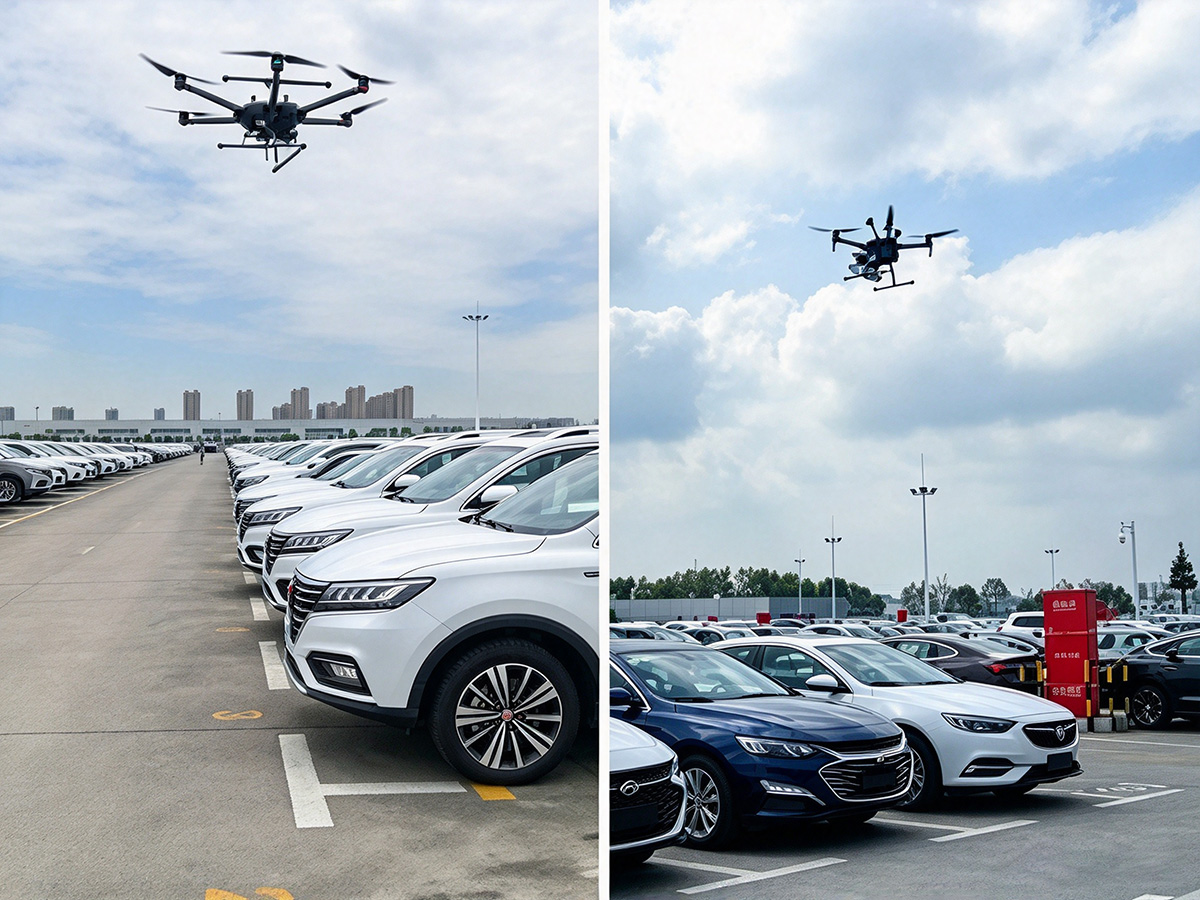
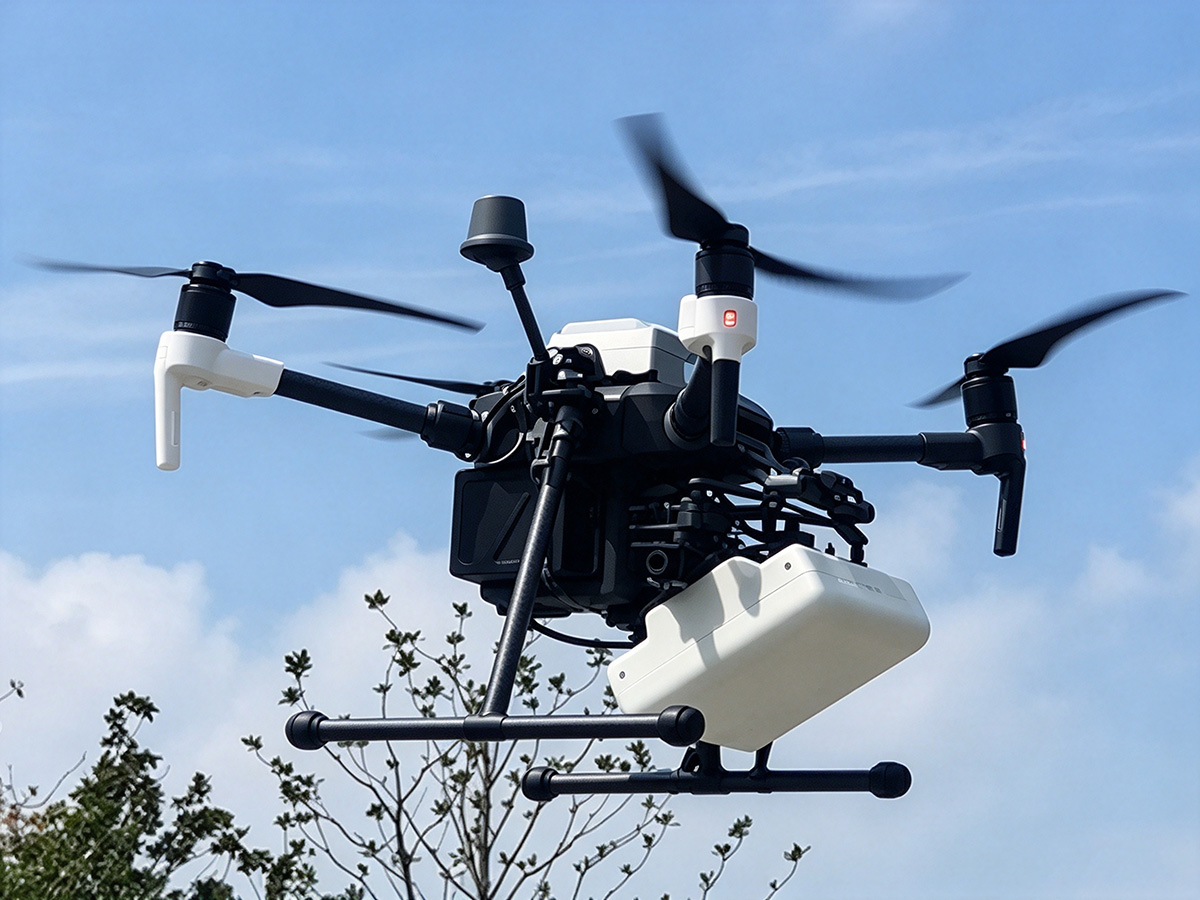
technical proposal | The UAV is equipped with a UHF RFID reader and flies autonomously along a preset route to read RFID tags on each vehicle in batches. |
Solution Provider | Beijing Xinlian Chuangzhan (Drone + RFID Inventory Counting Solution) |
Key Outcomes | ① Inventory cycle time is reduced by more than half, with no need to halt warehouse operations; ② Inventory accuracy approaches 100%; ③ Manual input decreased by approximately 50% year-on-year; ④ Real-time data upload during flight; combined with GPS positioning, this enables rapid location tracking of individual bicycles. |
Data source: Public reports by industry media on SAIC Anji Logistics' drone + RFID inventory project (see the sources list at the end of the article for details).
II. Project Background: Finding a Car in a 5,000 m² Garage
Anji Logistics manages millions of vehicles transported by SAIC within China annually. Its garages must keep track of the condition, quantity, and parking location of thousands of vehicles, as well as conduct regular inventory checks. The challenge lies in identifying the objects—each vehicle's identity is marked by the VIN (Vehicle Identification Number) printed on the inside of the windshield.
Locating and transcribing each of these VIN codes one by one in a 5,000 m² warehouse would be tantamount to searching for a needle in a haystack for the employees. Before the retrofit, the operating procedure was as follows:
• Labor-intensive — requires six employees to work continuously for six to seven hours and walk throughout the entire warehouse;
• Prone to errors — manual visual recognition combined with handwritten or handheld VIN entry results in a high error rate, and accuracy declines as fatigue increases;
• The garage must be shut down — To ensure data accuracy, the garage must be taken offline for approximately 24 hours during the inventory period, resulting in nearly a full day of operational disruption;
• Data lag — data is collected offline first and then uploaded, resulting in a noticeable lag in inventory data.
For a full-vehicle logistics company with annual transport volumes of several million vehicles, a single inventory count requires a day of warehouse downtime; the cumulative loss in working days and opportunity costs can be substantial—precisely where UHF RFID proves its value.
III. Technical Solution: Launching the Reader into Space
3.1 Vehicle Layer: Each vehicle has an "electronic license plate" that can be read remotely.
Each finished vehicle is equipped with a UHF RFID tag containing the vehicle's unique identification information, which is associated with its VIN. Passive UHF tags require no external power; they transmit data back simply by being activated by the reader's radio-frequency energy. This feature is particularly critical for vehicles in long-term storage inventory, as the tags require zero maintenance throughout their entire inventory lifecycle.
3.2 Data Acquisition Layer: The UAV is equipped with a reader and flies autonomously along a predefined flight path.
The drones are equipped with high-precision UHF RFID readers and fly autonomously along preset routes, covering every corner of the warehouse. Compared with manual walking, their elevated perspective and mobility enable them to navigate easily through complex vehicle parking environments and perform comprehensive scanning and identification of vehicles below; in large garages, they can be recharged with batteries at midday and continue operating continuously.
3.3 Transport Layer: Real-time telemetry during flight; GPS-assisted positioning
During actual flight operations, the drone can upload the data it collects in real time, eliminating the need to wait until it has landed before exporting the data; this enables inventory data to be updated nearly in real time. In conjunction with GPS information, the system can quickly locate a specific vehicle each time inventory is updated, transforming "vehicle location" from an experience-based task into a simple query operation.
3.4 Platform Layer: Association of Tag Data with the Cloud Database
RFID tags can store large volumes of data and connect to the cloud, linking the labeled physical items to a cloud-based database; this enables enterprises to track vehicles in real time and collect data, thereby supporting subsequent scheduling, dispatching, and inventory-taking decision-making.
3.5 Equipment and System Composition
Top class | Equipment / Systems | Act on |
Identification layer | Vehicle UHF RFID tag (passive; capable of writing unique information such as VIN) | Assign each vehicle a digital identity that can be read in bulk over long distances. |
Collection layer | UAV-mounted UHF RFID reader + airborne antenna | Fly autonomously along the designated route and batch-read the vehicle tags below. |
Positioning layer | GPS module / storage location coordinates | Synchronize location recording during reading; supports rapid单车 search. |
transport layer | Wireless real-time data backhaul | Upload data during flight; inventory is updated nearly in real time. |
Platform Layer | Cloud-based inventory database / WMS | Tag data is linked to vehicle records, supporting inventory taking and dispatching. |
Supplementary Tools | UHF handheld terminal | Abnormality re-inspection, individual vehicle supplementary reading, and random sampling |
IV. Comparison of Workflows: Before Renovation vs. After Renovation
link | Before modification (manual entry + VIN transcription) | After retrofitting (drones + UHF RFID) |
Inventory Preparation | Manage vehicle flow in the temporary parking garage; assign a team of 6 personnel. | No facility shutdown required; normal operations remain unaffected. |
DA | Six employees walked for 6–7 hours, locating vehicles one by one and transcribing the VINs. | Predefined flight path + one-click takeoff: autonomous drone flight and data acquisition |
Upload data | Once data collection is complete, the data will be centrally entered, corrected, and uploaded. | Real-time upload during flight; data is updated nearly in real time. |
error analysis | Manual identification is prone to errors, and accuracy declines over time. | Automatic recognition results in fewer errors, while accuracy does not decline as the duration of the task increases. |
Vehicle Location Search | Relying on memory and experience is like searching for a needle in a haystack. | Combine GPS and tag data to directly locate individual bicycles. |
human input | 6 people per session × more than half a day | Manual labor input decreased by approximately 50% year-on-year |
V. Implementation Outcomes
5.1 Achievements Realized in This Project (Case Facts)
dimension | Implementation Results |
Review Efficiency | Processing time has been reduced by more than half; the workload that previously required 6–7 hours for six people can now be completed using a single preset route. |
Inventory accuracy | Inventory accuracy has reached nearly 100% |
human cost | The manual labor required for VIN tracking has decreased by approximately 50% year-on-year, enabling employees to shift toward higher-value work. |
Operational continuity | No more waiting for a 24-hour inventory check; the garage can operate normally around the clock. |
Data timeliness | Real-time upload during flight; inventory data shifts from lagging to near real-time |
safety | Reduce the number of people entering areas with heavy traffic flow to mitigate safety hazards. |
5.2 Industry-based quantitative reference for warehousing and logistics scenarios (not based on actual measurement data from this project)
The following are publicly available industry data used to estimate the input–output ratios for comparable projects; please do not directly use them interchangeably with this case study, as the measurement criteria differ:
Metric | Before deployment | After deploying UHF RFID | Data sources |
Full-Vehicle Inventory Count | Manual walking collection requires the warehouse to be shut down. | Drones + RFID: efficiency increased by over 60% | Industry media coverage of the Anji Logistics Project |
Warehouse inventory counting efficiency | Total number of days per month | UHF 10-meter-range batch reading: inventory efficiency increased by 80%, with an accuracy rate of approximately 99% | Public Data from JD.com's Digital Twin Warehouse |
Inbound/Outbound Verification | Manual item-by-item scanning | The access-controlled reader reads dozens to hundreds of tags in a single operation, automatically matches them against orders, and issues alerts. | Publicly Available Information on Warehouse RFID Solutions |
sorting operation | People search for goods; extensive walking is required. | Reader + AGV "goods-to-person" sorting reduces manual walking distance by over 80% | Open Data for Logistics Center RFID + AGV |
Transportation error rate | Manual verification | Transportation error rate reduced by 80%; on-time delivery rate increased to 99.5% | Publicly Available RFID Application Data from Logistics Enterprises |
Inventory accuracy rate | Manual inventory: approximately 82% | Increased to 99.7%; inventory turnover time reduced from 48 hours to 6 hours | Publicly Available Data on RFID Applications in Fast-Fashion Brands |
Material preparation efficiency | Manual sourcing | Material preparation time reduced by over 60%; inventory counting efficiency increased from 1.05 items/min to 4.50 items/min. | Public Data for the WMS + UHF RFID Solution |
VI. Four UHF RFID Deployment Models for Warehousing and Logistics
Deployment topology | Equipment Configuration | applicable scene | Pain points addressed |
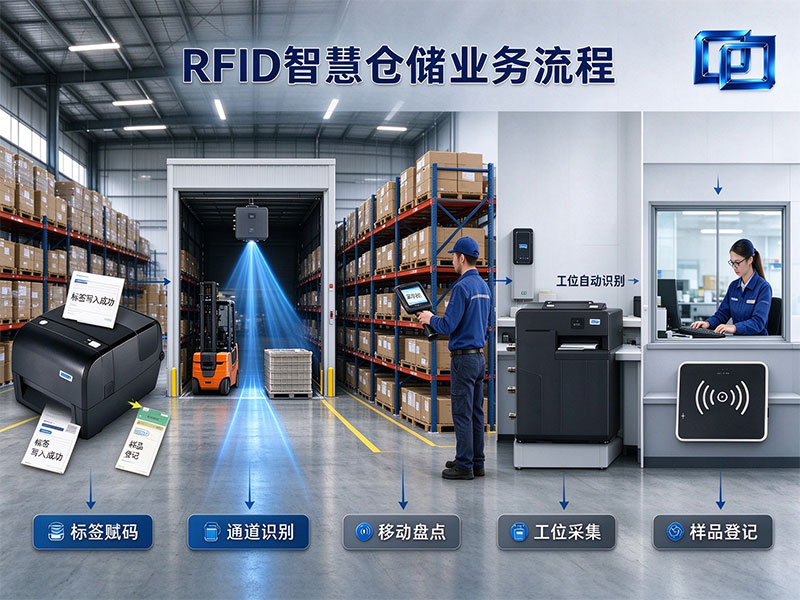
Pass-through door / access-controlled door | Fixed reader + antenna + infrared/ground-induction trigger | Inbound/outbound gates, platforms, sorting lines | Full pallet/full case batch verification without unpacking; seconds-to-complete inbound and outbound processing |
Forklift-mounted | Vehicle-mounted reader + antenna + vehicle-mounted terminal | High-level rack retrieval and storage, and in-warehouse relocation | Deposit and withdrawal operations constitute data collection; this prevents the need for retroactive data entry. |
Handheld mobile | UHF handheld terminal | Warehouse inventory, item location, random sampling, and verification | Batch reading anytime, anywhere—flexible and cost-effective |
Aerial / Mobile Robots | Drone or AGV-mounted reader | Large-scale storage yards, full-car warehouses, and high-bay warehouses | Cover areas difficult to access manually and complete inventory counting without requiring stockpiling |
The Anji Logistics Project represents the fourth form of operation; it also features the highest level of warehousing automation and the most comprehensive replacement of manual labor.
VII. Why choose UHF RFID for warehousing and logistics rather than barcodes or manual processing?
Comparison dimension | UHF RFID | 1D / QR Code | manual record |
Reading method | RF operates beyond line-of-sight and can penetrate packaging. | Must be visible, properly aligned, and scanned item by item. | Visual identification + manual entry |
Batch capacity | Dozens to hundreds of tags per second, with the entire tray read in a single operation. | One at a time | One at a time |
Read distance | From several meters to the 10-meter class | close encounter | You need to get close to them. |
Environmental Tolerance | The label is stain-resistant, wear-resistant, and weather-resistant. | Contamination, wrinkling, or obstruction results in failure. | Affected by lighting and fatigue |
Is it necessary to suspend storage? | Not required; dynamic inventory can be maintained. | Usually required | The warehouse must be shut down |
Data timeliness | Real-time / Near-real-time upload | Centralized post-event data entry | Significant lag |
Single-product-level traceability | Supported (Unique ID + Cloud Binding) | Category-level only | nonsupport |
limit | Metal and liquid environments require dedicated labels. | Low cost and easy deployment | Efficiency and Accuracy Bottlenecks |
VIII. Implementable Hardware Configuration List (Reference BOM)
Using a medium-sized warehousing facility with a ten-thousand SKU portfolio and an average daily inbound and outbound volume of several thousand items as the baseline configuration:
Device class | Recommended Specifications | Reference quantity | Use |
Four-channel UHF fixed reader | EPC C1G2 / ISO18000-6C,4-antenna configuration, dense reading with conflict avoidance | 4 – 8 units | Batch verification of inbound/outbound aisle doors, platforms, and sorting lines |
Pass-through door antenna / door frame | 8–9 dBi circular polarization, with infrared or ground-induction triggering | Configure by number of channels | Create a controlled read zone to avoid misreading adjacent channels. |
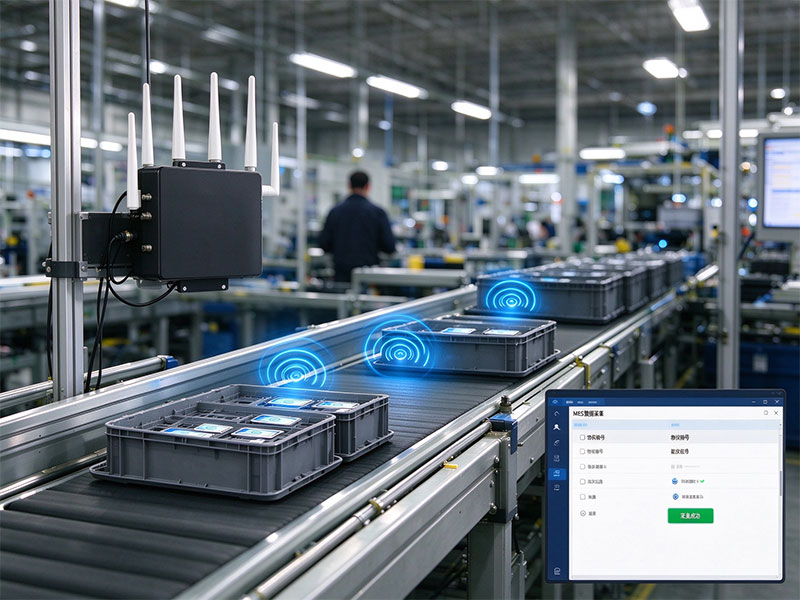
UHF metal-resistant tags | PCB / ceramic substrate, IP67, high and low temperature resistance, metal surface read distance exceeding 10 m | Configured according to the metal substrate | Metal shelving, metal pallets, turnover containers, containers, complete vehicles |
UHF Self-adhesive Labels (General Purpose) | Higgs-9 or equivalent chips, EPC 96 – 496 bits | Configure by SKU and case quantity | Cardboard boxes, plastic packaging, pallet labels |
UHF handheld terminal | Android OS, group reading ≥ 200 tags/s, supports inventory apps | 4 – 10 units | Warehouse inventory, item location, random sampling, and abnormality re-inspection |
Vehicle-mounted UHF reader (optional) | Seismic design; vehicle-mounted antenna and terminal | Configure based on the number of forklifts | Deposit/withdrawal operations constitute data collection; automatic accounting is performed upon movement within the ledger. |
RFID tag printer | Industrial-grade; supports write verification and automatically discards defective labels. | 2 – 4 units | Warehouse receiving and labeling, label replenishment, and printing of pallet/warehouse location labels |
Warehouse location label | Metal-resistant or wear-resistant UHF tags | Configured by container capacity | Digitalize storage locations to make "storage location the coordinate." |
UAV / AGV Load/Read Module (Advanced) | Lightweight read/write module + wireless data backhaul | 1–2 sets | Continuous stocktaking in large-scale storage yards and high-level warehouses without shutting down operations |
WMS / Middleware | Supports EPC event filtering and integration with ERP/WMS | 1 set | Inventory visualization, inbound/outbound verification, and early warning |
IX. Key Implementation Considerations: Six Common Pitfalls
1. Tag selection — Metal shelving, metal pallets, and containers must use metal-resistant tags; liquid and organic cargo (meat, beverages, chemical products) absorb radiofrequency energy, so liquid-resistant tags should be selected with increased readout power. Under these conditions, the readout rate of standard tags may fall below 50%.
2. Metal Environment — When metal shelving accounts for more than 80% of a warehouse's inventory, label isolation must be implemented; label costs will increase by 2–3 times, so this factor should be factored into the budget during the planning stage.
3. Interference from adjacent channels — The power and antenna angle should be optimized for both sides of the channel door and the adjacent channels; where necessary, shielding should be implemented or the power reduced to prevent the system from reading cargo in neighboring channels or in the area under inspection.
4. Coding Standards — Tag encoding rules must be standardized (it is recommended that the EPC coding standards be followed); otherwise, the costs associated with later cross-system integration and data governance will be extremely high.
5. Tag density — In high-density scenarios (more than 500,000 tags in a single database), tag collisions may occur; therefore, the reader's conflict avoidance algorithm and inventory strategy should be evaluated.
6. Interfaces and Data — Prioritize devices that use open protocols (e.g., those supporting the LLRP/EPC Gen2 standard) to ensure seamless integration with existing WMS and ERP systems; simultaneously implement proper access control and data encryption.
X. Related Extended Cases
Case | Location / Time | Key Points of the Plan | Public Impact |
Asia Shipping Group: Warehouse Automation | State of Santa Catarina, Brazil; to be announced in 2026 | Three sites totaling 20,000 m² serve over 50 customers; by integrating RFID with automation, AI, and real-time monitoring, the system enables batch reading of entire pallets and automatically compares orders with the actual goods before loading, issuing alerts for any discrepancies. | Full warehouse inventory checks have been reduced from up to 14 days to approximately 30 minutes; pre-loading verification has been shortened from 2 hours to 5–10 minutes; truck bay dwell time has been reduced from approximately 5 hours to 30–40 minutes; overall productivity has increased by 80%; and one person can now complete the workload that previously required up to four people. |
JD Digital Twin Warehouse | China | UHF tag batch read capability at the 10-meter range | Inventory counting efficiency increased by 80%, with an accuracy rate of 99% |
AGV "goods-to-person" system at a logistics center | China | Automated data collection via access-controlled readers + AGV transport of shelves according to instructions | Enable "goods-to-person" sorting, reducing the distance walked by more than 80% |
Zara Store and Supply Chain RFID | the whole world | Single-item-level UHF RFID tags and handheld terminal inventory counting | Single-store inventory count time has been reduced from 3 days to 2 hours. |
Fast-Fashion Brand Monthly Comprehensive Review | China | Handheld UHF RFID terminal for shelf scanning | The monthly cycle was shortened from 48 hours to 6 hours, while inventory accuracy improved from 82% to 99.7%. |
GAO RFID Cross-Dock Operations Series | Multiple locations across the United States | UHF RFID cross-docking systems can be deployed using either a cloud-based or on-premises server architecture, depending on the specific use case. | Outbound temporary storage errors decreased by 31%; misdelivery incidents decreased by 41%; material shortages at production lines decreased by 24%; peak-season throughput increased by 19%, while labor requirements did not increase year-on-year. |
Note: The publicly available documentation for the Grupo Asia Shipping project does not explicitly specify the frequency band or air interface protocol used; this table cites the "RFID + Automation" case as a reference and does not serve as direct evidence supporting the UHF frequency band; all other cases explicitly specify UHF / ultra-high-frequency solutions.
XI. Conclusion
The value of the Anji Logistics case lies in its precise identification of the most costly component of warehousing and logistics: the downtime incurred in order to obtain accurate data. The fundamental issue with manually entering VINs is not that people are not fast enough, but that "one must first come to a stop in order to count accurately." UHF RFID transforms this process into an action that can be carried out concurrently during operations: tags are passive and require no maintenance; readers can perform batch reads over long distances; and the carriers can be personnel, forklifts, AGVs, or even drones.
For warehousing customers planning to implement RFID, the recommended approach is as follows: first implement pilot deployments in high-value categories or areas with high error costs—for example, at inbound and outbound aisle gates—to measure read rates and accuracy until they reach an acceptable level; then expand the deployment to inventory counting, item location, sorting, cross-docking, and other processes. The technology itself is already mature; success depends on four key factors: tag selection, antenna layout, coding standards, and integration with the WMS.
data sources
· Industry Media — SAIC Anji Logistics' "Drones + UHF RFID" Whole-Vehicle Inventory Counting Project Report (Primary source of this case study)
· SAIC Anji Logistics Co., Ltd. — Official Website: Company Profile and Business Scale
· Beijing Xinlian Chuangzhan — Public Documentation on the Drone + RFID Inventory Counting Solution
· RFID News —《Automation cuts stocktaking from 14 days to 30 minutes for Grupo Asia Shipping》
· GAO RFID — RFID Cross-Docking Systems: Case Studies on Cross-Docking Operations
· RFID World Network / Industry Media — JD.com warehouses, Zara, fast-fashion brands, and WMS + UHF RFID application data
This document was compiled by WorkBuddy for use as a reference for solutions and client communication; all third-party data have been properly attributed, and project-measured data should not be mixed with industry statistical data.

Scan To Add

Scan To Add
Copyright © 2026 Shenzhen Zhishun Information Technology Co., Ltd All Rights Reserved.
Technical Support:SYSX





 182-7997-4925

 Home